US History - Extended Response
Baseline Assessment
Student Login
Source Documents
Read and study the sources about the American transportation system in the late nineteenth and early twentieth centuries. As you read the four sources, think about how the development of the transportation system in the United States affected the country economically and culturally. After you read the sources, answer the question.
Source 1: Railroad Networks (1870-1890)
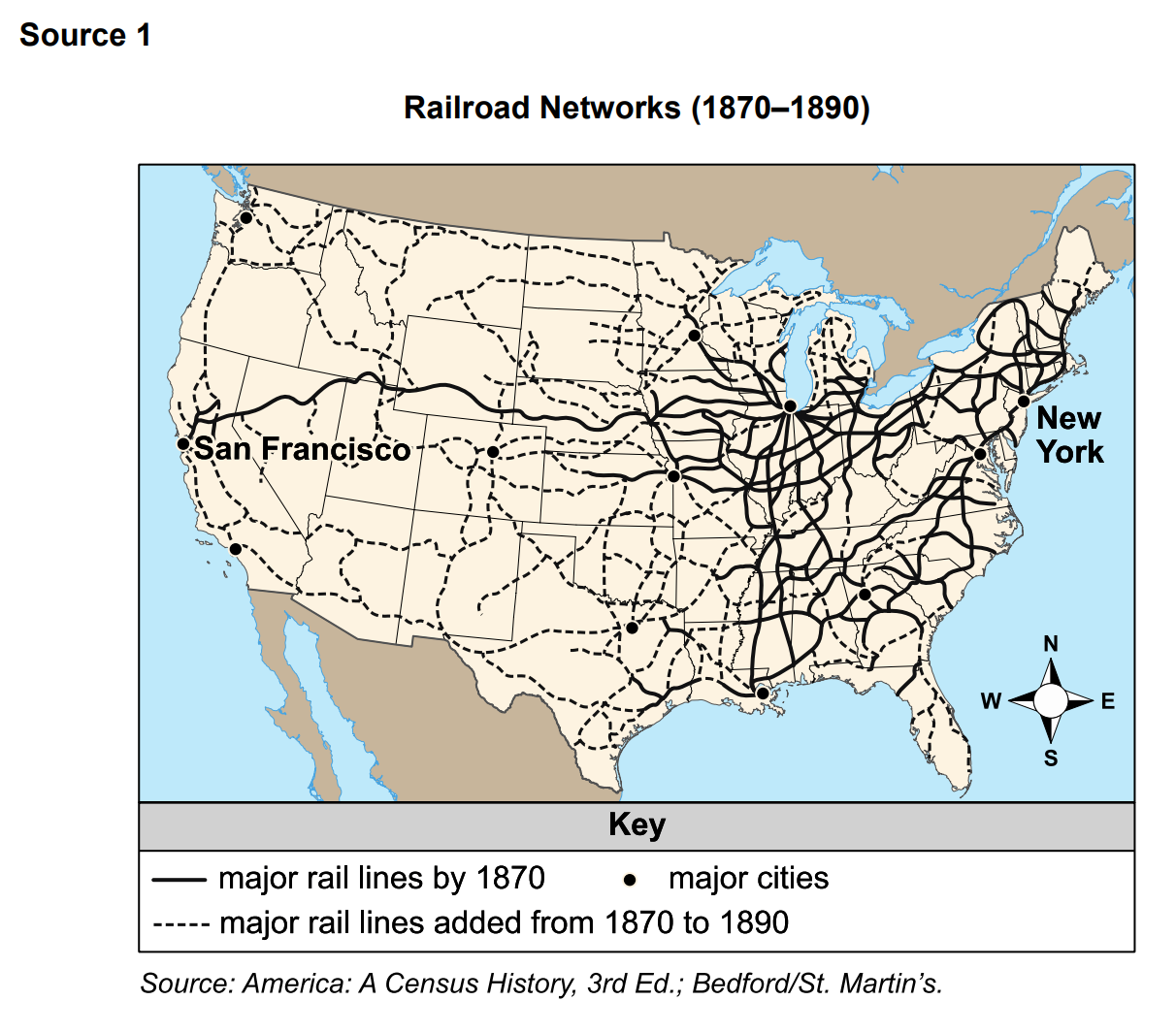
Source: America: A Census History, 3rd Ed.; Bedford/St. Martin's.
Source 2: Excerpt from Facing Aviation's Critics (August 1928) by Richard E. Byrd
This excerpt is from an essay that appeared in the magazine The Forum, in response to the proposition "Has aviation a commercial future?" It was written by Rear Admiral Richard E. Byrd, an American naval officer, aviator, and polar explorer.
We are in a seventh heaven of self-esteem over this thrilling matter of human flight which the Wrights—our countrymen—have made possible. Again, being an imaginative people, we cannot resist the temptation to speculate extravagantly about the future of aviation. . . .
Probably the strongest argument wielded by critics of aviation is that which defines the limits of flying from the viewpoint of the railway and automobile. A common formula is this: "The railway and the automobile outgrew the period of danger to their passengers. Therefore, if flying is ever to replace them, it must likewise emerge from its present hazards." It is true that in 1845 the railway was viewed much as the layman looks on flying today. . . .
The American citizen of 1839 did not picture the gigantic engineering machinery that would make it possible to build our transcontinental roadbeds . . . nor the tumultuous rush of twentieth-century existence that necessitates high-speed transportation.
In the same way, early critics could see no future for the automobile. . . . The American of 1897 did not foresee an automobile tire that would last for 20,000 miles, an engine that would go 150,000 miles, nor a public opinion that would support a budget of $200,000,000 for good roads. . . .
However, it is not profitable to meet critics of aviation simply by declaring that their arguments are behind the times. . . .
It may seem . . . that the plane can never compete with the ship or train as a carrier of passengers or freight. Possibly so. . . .
"Fanatic" they call us today for warmly supporting aviation. But . . . I am confident that flying has a future as yet undreamed of, and that in a few years these hot blasts now issuing against it will read as foolishly as do the original arguments against the railway and the automobile. . . .
The greatest progress and the development that will mean most to aviation must come from banking support. So far this support has been very limited, but it is increasing markedly as more successful flying is done. When American business joins hands with American aviation, the future of flying is assured.
Source: Becoming Modern: America in the 1920s. Copyright 2012 National Humanities Center. All rights reserved.
Source 3: Excerpt from The Story of My Life (1932) by Clarence Darrow
This excerpt is from the memoir of Clarence Darrow, a lawyer associated with many high-profile cases of the early twentieth century.
The day of the horse is gone. The automobile has driven him from the roads. The boys and men and women of this generation must have automobiles. Those who manufacture them and sell them have made fortunes unknown in any former age. Every automobile costs more to sell than to make. No one can even guess at the cost of this new invention to the country or the change that it has brought to life. New roads have been built at great expense so men may ride quickly to some point so they can ride back more quickly if possible. Finance companies have helped the poor to get further into debt; an automobile complex . . . has taken possession of mankind. . . .
These machines have been used to make a quick trip to the doctor to save human life, to make a long trip to a bank or store . . . all in order to keep up with the progress and process of a moving world. The automobile symbolizes both good and evil. The organism of man is not so adjustable and changeable as his inventions. It will take him a long time to accustom himself to the automobile age.
Source: Becoming Modern: America in the 1920s. Copyright 2012 National Humanities Center. All rights reserved.
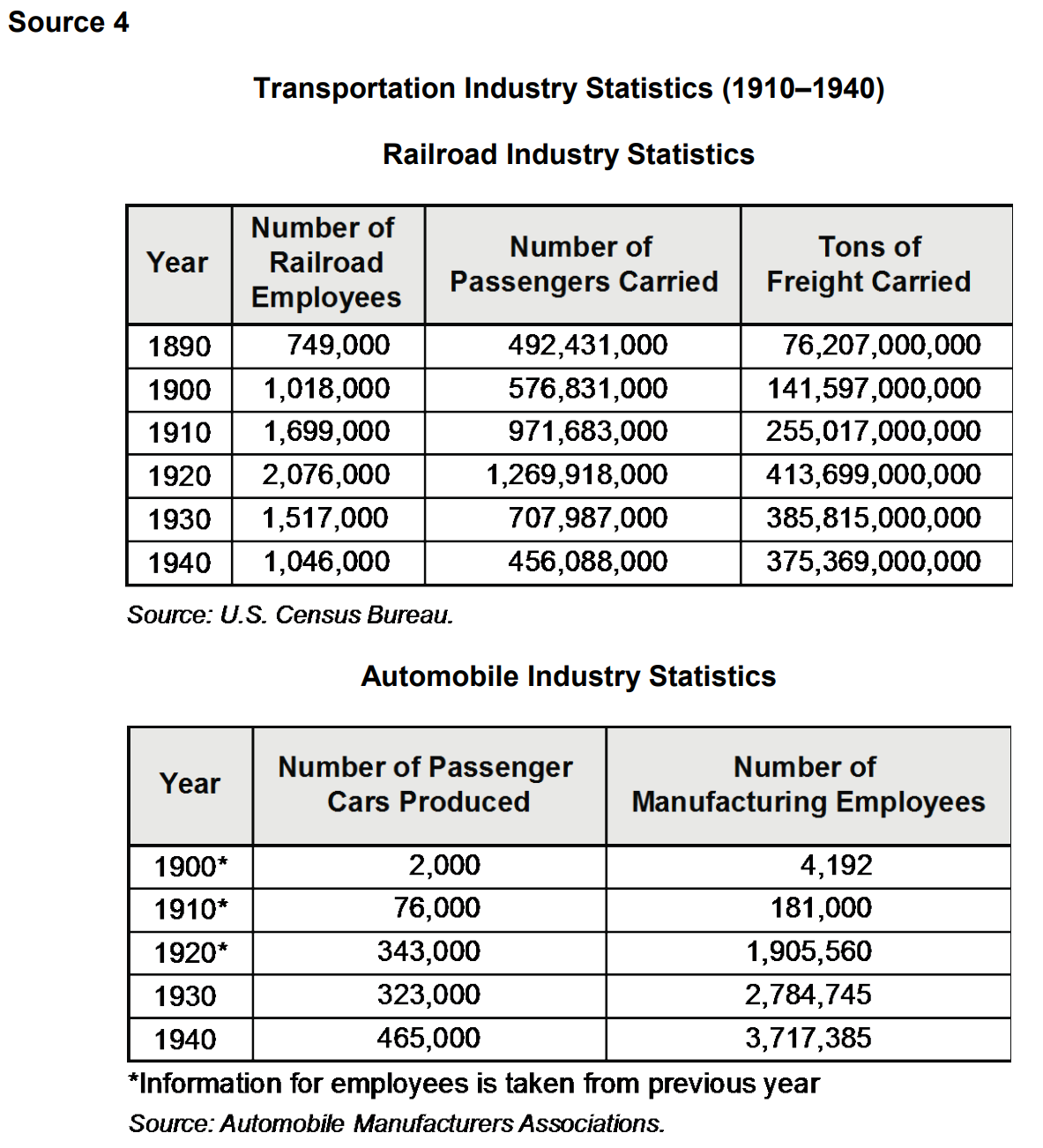
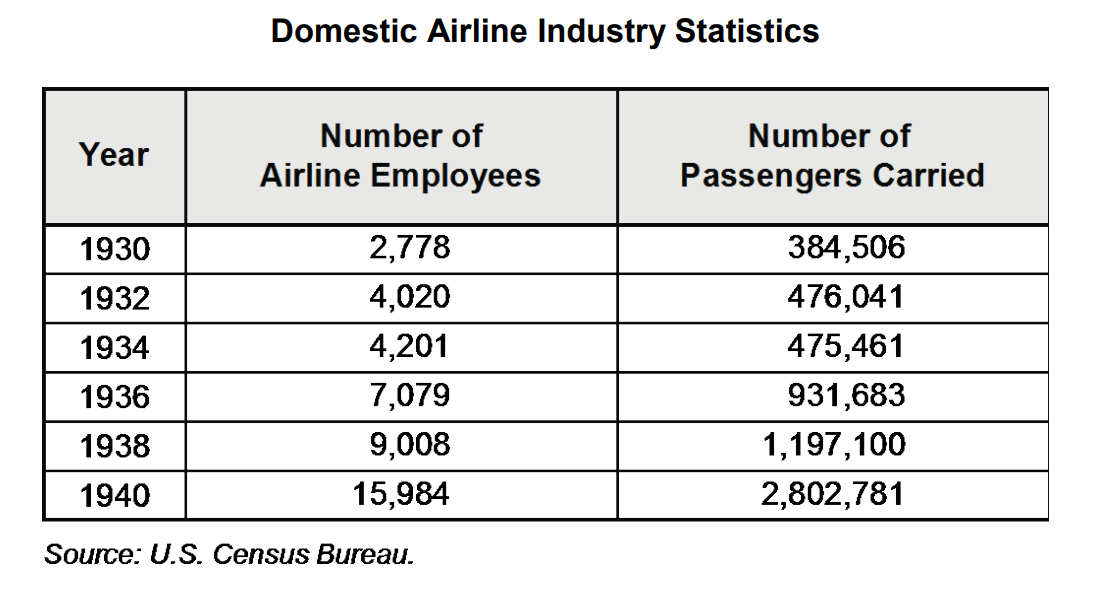
Source 4: Transportation Industry Statistics (1910-1940)
Your Task
Based on the sources and your knowledge of U.S. history, analyze how the development of the transportation system in the United States affected the country economically and culturally in the late nineteenth and early twentieth centuries.
As you write, follow the directions below:
- Address all parts of the prompt
- Include information and examples from your own knowledge of U.S. history
- Use evidence from the sources to support your response
Your Response
Words: 0