US History - Constructed Response
Baseline Assessment
Student Login
Source Documents
Read and study the sources about political machines, corruption, and Progressive reforms. Then use the four sources and your knowledge of U.S. history to answer the question.
Source 1: Excerpt from To Hold Your District: Study Human Nature and Act Accordin' by George Washington Plunkitt
This excerpt is from a speech given by George Washington Plunkitt, a member of the Tammany Hall machine, who also served as a state senator between 1884 and 1904.
THERE's only one way to hold a district: you must study human nature and act accordin'. . . .
To learn real human nature you have to go among the people, see them and be seen. I know every man, woman, and child in the Fifteenth District . . . I know what they like and what they don't like, what they are strong at and what they are weak in, and I reach them by approachin' at the right side. . . .
What tells in holdin' your grip on your district is to go right down among the poor families and help them in the different ways they need help. I've got a regular system for this. If there's a fire in Ninth, Tenth, or Eleventh Avenue, for example, any hour of the day or night, I'm usually there with some of my election district captains as soon as the fire engines. If a family is burned out I don't ask whether they are Republicans or Democrats, and I don't refer them to the Charity Organization Society, which would investigate their case in a month or two and decide they were worthy of help about the time they are dead from starvation. I just get quarters1 for them, buy clothes for them if their clothes were burned up, and fix them up till they get things runnin' again. It's philanthropy, but it's politics, too—mighty good politics. Who can tell how many votes one of these fires bring me? The poor are the most grateful people in the world, and, let me tell you, they have more friends in their neighborhoods than the rich have in theirs.
If there's a family in my district in want I know it before the charitable societies do, and me and my men are first on the ground. I have a special corps to look up such cases. The consequence is that the poor look up to George W. Plunkitt as a father, come to him in trouble—and don't forget him on election day.
Another thing, I can always get a job for a deservin' man. I make it a point to keep on the track of jobs, and it seldom happens that I don't have a few up my sleeve ready for use. I know every big employer in the district and in the whole city, for that matter, and they ain't in the habit of sayin' no to me when I ask them for a job.
1quarters: lodgings
Source 2: The Spirit of Tweed is Mighty Still by Thomas Nast
This political cartoon was published by Harper's Weekly in 1886 with the caption: "The spirit of Tweed is mighty still . . . and even yet you don't know what you are going to do about it!"
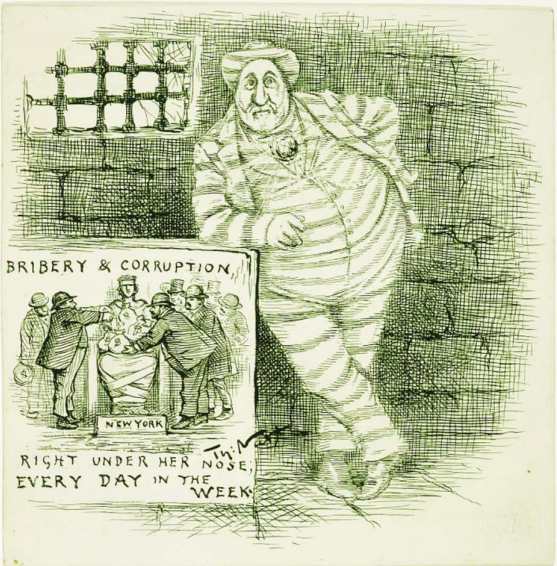
Source: Library of Congress
Source 3: Excerpt from What Will the Harvest Be? by Robert La Follette, Sr.
This excerpt is from campaign literature for Senator Robert La Follette that was published in the early twentieth century.
What Will the Harvest Be?
There was a time in Wisconsin when the boss and representatives of the railroads nominated the candidates for both parties. How? By intervening between the voter and the nomination and "getting" the delegates.
You remember how it was done; railroad passes, entertainment, money, influence. Men who could not be elected as delegates sat in conventions on proxies1 purchased as merchandise. Delegates honestly elected were unseated by fraud, and contesting delegates seated. These were some of the means.
There was a time in Wisconsin when the railroads ruled and ruled supreme. They openly boasted of their power. For more than thirty years no law was enacted except by consent of the railroads.
La Follette secured the anti-lobby law and drove from the capitol some of the most corrupt and notorious characters of the age. This law must be enforced.
La Follette secured the anti-pass law and thus did away with the common and wholesale bribery of public officials.
La Follette secured the corrupt practices acts designed to purify the caucuses2 and elections. This law must be strengthened and enforced. It has been flagrantly violated in recent years.
La Follette, with a clear vision, saw then what Roosevelt and Hughes3 see now—that the people must be freed from boss rule.
La Follette secured the primary election law. Under the primary law you vote direct for your choice, your vote is your own, if there is failure it is your failure. Make the fight for right men and right laws in the open, as you can, and you will win.
This great movement in Wisconsin has given Wisconsin a reputation throughout the nation. It is the Wisconsin Idea and other states are following in its wake.
1proxies: substitutes, representatives
2caucuses: meetings of political party members to select candidates
3Hughes: Charles Evans Hughes, a Republican governor who was part of the Progressive movement
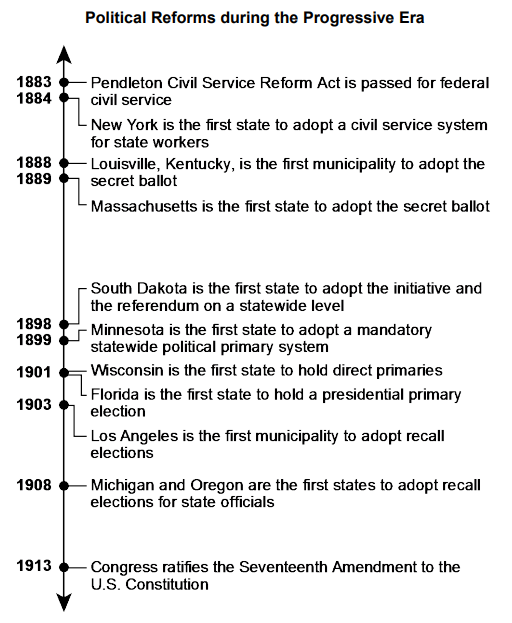
Source 4: Political Reforms during the Progressive Era
Your Task
Describe one problem caused by political corruption and explain how Progressives proposed to reform that problem.
In your response, be sure to:
- Address all parts of the prompt
- Include information and examples from your own knowledge of U.S. history
- Use evidence from the provided sources to support your response
Your Response
Words: 0